
Perspectives
The Hardest Miles
November 2026
desire to give up, it is actually the point of being nearest to success."
- Eliud Kipchoge, Two time Olympic gold medalist and first human to complete a marathon in under
two hours
The past two years have been rough for Indian equities. In the two years ended September 2026, the Nifty 50
has fallen 12.4% while the rupee has declined a further 12.7% against the dollar. In this period, foreign
institutional investors have withdrawn about $56 billion from Indian equities, and India’s weight in the MSCI
Emerging Markets index has shrunk from 19.8% to 10.7% as global capital preferred to chase the AI trade. The
scale of this shift is striking: Taiwan-based TSMC alone now commands an index weight 50% greater than India’s
entire allocation, while the three largest emerging-market companies (TSMC, Samsung, and SK Hynix), all riding
the AI wave, collectively account for 30% of the index, nearly three times India’s weight.
This sharp reversal in foreign investor sentiment is particularly notable given where India stood just two years
ago. At the time, when Indian valuations had soared to what we called “dizzying heights”, we argued that the
departure of foreign hot money was unlikely to pose a risk. What we underestimated was how far valuations
could fall, even with domestic money still flowing in. Beneath the index, though, the picture is far less bleak than
these headline numbers suggest.
Cheaper, Not Weaker
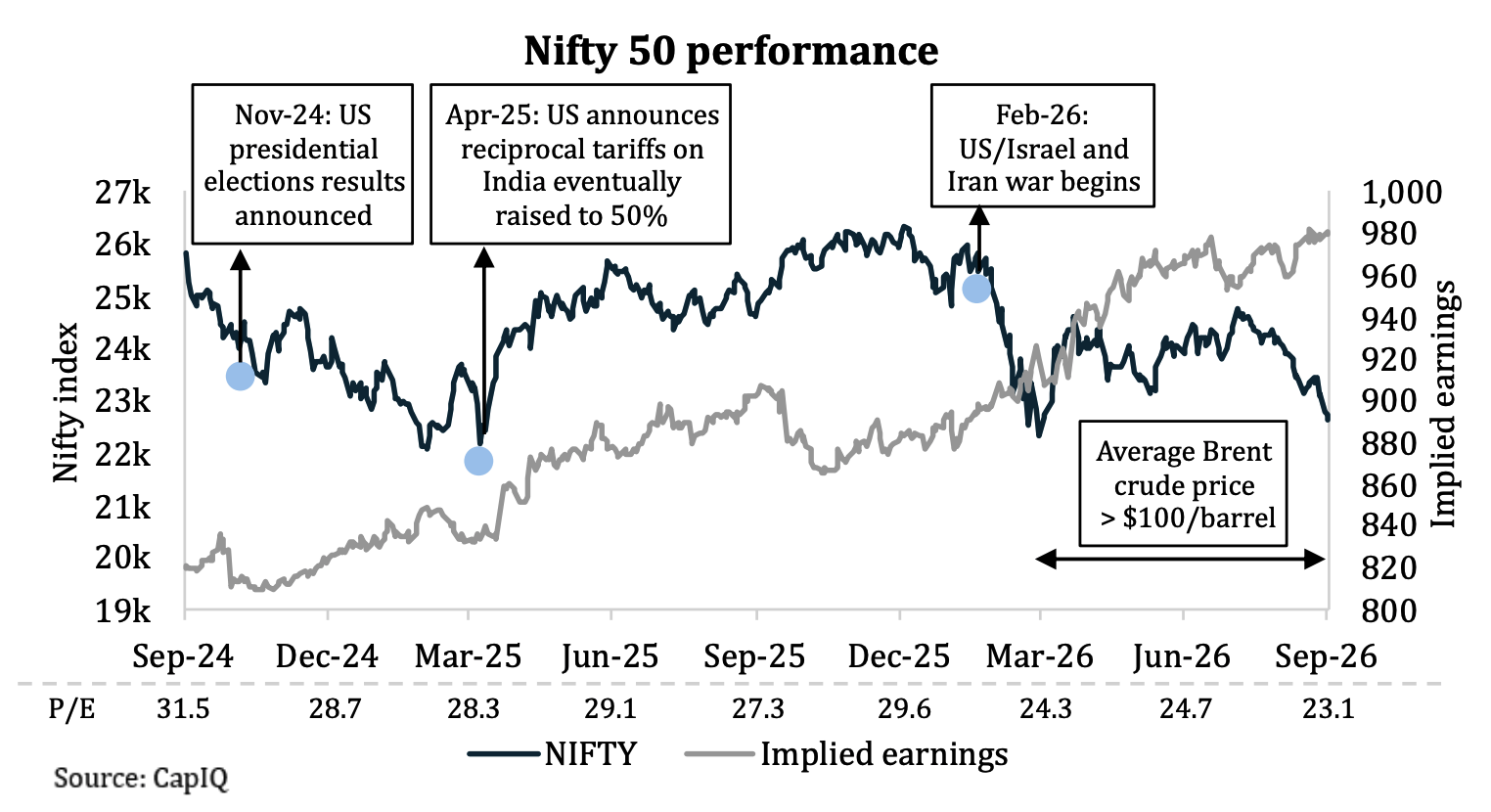
While valuations have declined,
corporate earnings have not. Over the
two years to September 2026, the Nifty
50’s implied earnings rose 19.5% even as
the index fell 12.4%.
The result is a market that has de-rated
by more than a quarter. The Nifty 50’s
trailing P/E fell from 31.5x in September
2024 to 23.1x in September 2026, its
lowest level since June 2020 and well
below the ten-year average of 28.7x. Nor
is earnings growth slowing: Nifty 50
profits grew at their fastest pace in ten
quarters in the June 2026 quarter.
Passing the Baton
Without any great fanfare, ownership of
India Inc. has quietly changed hands.
Foreign portfolio investors held 8.7% of
NSE-listed companies in FY01 which
rose to a peak of 22.1% in FY14.
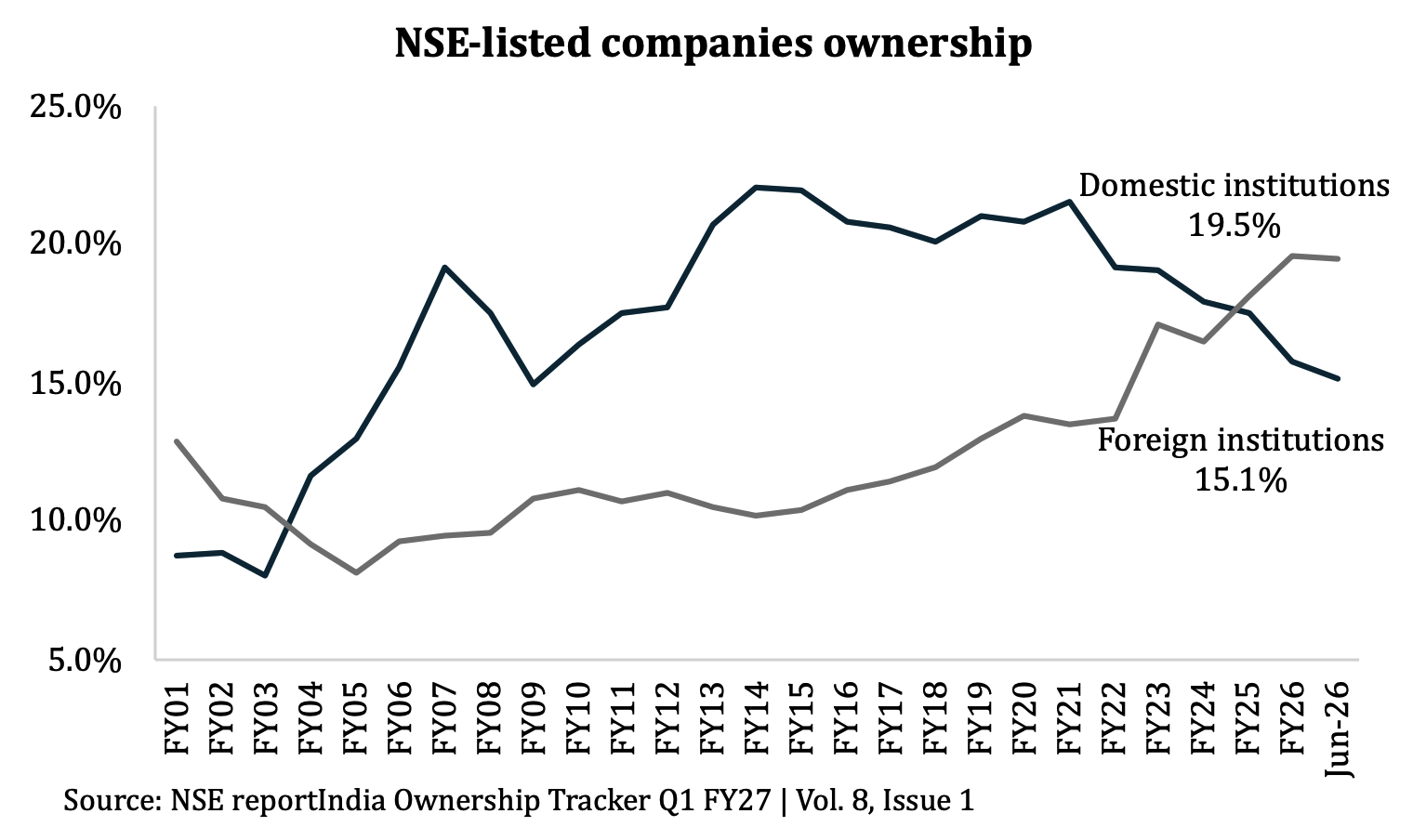
Post covid and particularly with the AI
and Trump variables omnipresent on
the global stage, foreign ownership
levels have reduced to 15.1% in June
2026, a 17-year low. Domestic
institutions, which held as little as 8.1%
in FY05, now own 19.5%, having
eclipsed foreign ownership in FY25 for
the first time in 22 years.
The dichotomy between foreign and domestic investment strategies is evident in the numbers. Over the 24
months to September 2026, domestic institutions invested $177 billion while foreigners sold $56 billion, more
than three dollars in for every dollar out.
Domestic buying appetite has consistently increased since 2005 and we expect this trend to continue and
become a dominant force henceforth. Reasons include regulatory changes that have favoured the growth of
private insurance and asset management companies (not permitted until the early 2000s), a muted interest rate
regime, and the rise of systematic investment plans (‘SIP‘) as a preferred savings device for India’s rapidly
expanding middle class. In September 2026, SIP contributions reached a record $3.4 billion, almost matching the
$3.8 billion of foreign investor withdrawals that month.
Where the Money Went
While the Nifty 50 index is down 12.4% in the two years ended September 2026, the aggregate market
capitalization of NSE-listed companies has remained largely unchanged in INR terms. The Nifty 50 companies
now account for 39.1% of total NSE market capitalization ($4.9 tn), down from 44.2% two years ago, belying a
balanced distribution of market values across the exchange rather than any kind of overconcentration.
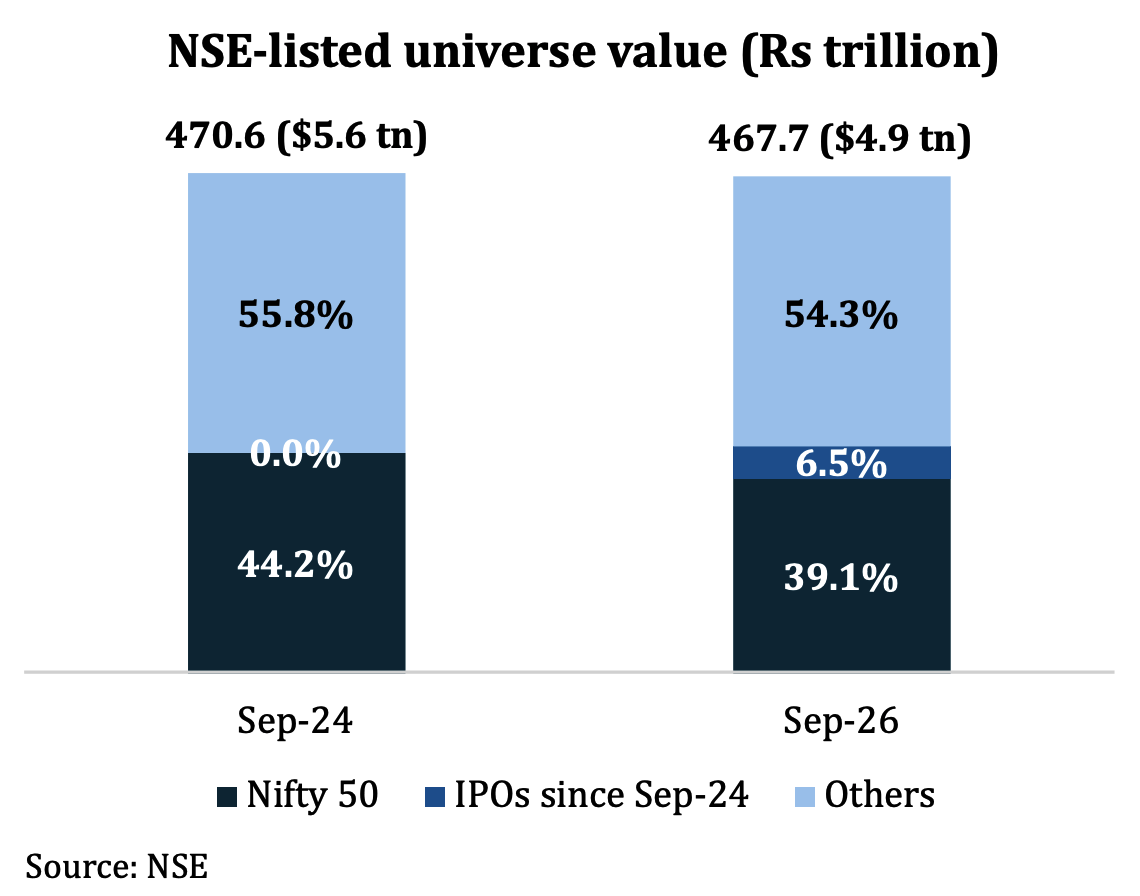
A continued wave of IPOs explain the stable market
capitalization despite the Nifty 50’s fall. Between October
2024 and September 2026, more than 210 companies
IPOed, raising roughly $43 billion. That is more than the
$41 billion raised in the previous four years combined, and
equal to 24.4% of all domestic investment during the
period. India’s three largest IPOs ever have all come in the
past two years: Hyundai Motor India in October 2024, the
National Stock Exchange in September 2026 and Jio
Platforms this October. Neither NSE ($50 billion) nor Jio’s
($137 billion) market capitalizations are counted in these
figures, so the true shift is larger still.
Money that might otherwise have bid up existing shares
has been absorbed by new paper, and a meaningful 57.6%
of IPO proceeds in FY26 went to existing investors cashing
out rather than to the companies themselves. Foreign
investors have been buyers here too: even as they sold existing shares, they put a record $14.5 billion into IPOs
and other primary issues in calendar 2024, almost exactly matching their secondary-market selling that year,
and a further $14.4 billion in 2025 and the first nine months of 2026. Demand for Indian equities has not dried
up; it has been spread across more companies.
The Second Half
- Haruki Murakami, best-selling author of ‘What I Talk About When I Talk About Running’
The risks are real: Oil, Dollar, AI – to name a few. Oil around $110 feeds straight into India’s import bill, and the
rupee is not far from its record low of about 97 to the dollar. India is widely cast as the biggest global loser from
AI, on the view, a young population and a large, skilled white-collar workforce, will count for less in an AI-first
world.
Historically, India has rarely set the pace in the first half of a technological shift, yet it has repeatedly adapted in
the second. India did not build the computers of the 1990s, but it created software services as one of its largest
industries. It largely missed the desktop internet revolution, only to leapfrog into mobile data and digital
payments through UPI. Barring the downturn in recent weeks, today’s index rewards the companies that make
the chips and train the models, but history suggests that is not necessarily where all the economic benefits of
technology ultimately accrue.
None of this should be mistaken for distress. Global capital may have followed the AI opportunity elsewhere, but
the economy it left behind is not in trouble. GDP grew 7.8% in the June 2026 quarter, unemployment was 5.0%
in September, below 5.2% a year earlier, and bank bad loans fell to a multi-decade low of 1.8%.
Artificial intelligence may change how work gets done, but it does not replace fundamental intelligence in
investing: owning good businesses at sensible prices. Two years ago, investors were paying 31.5x trailing
earnings for the Nifty 50, a price that reflected confidence that the good times would continue. Today they pay
23.1x for earnings that are 19.5% higher, in a market whose total value has held up and whose institutional
investors are now more domestic than foreign. The risks have not gone away, but the price of taking them has
improved.
Nobody knows whether this is the time to buy or to sell, and we will not pretend to. Markets, like marathons, are
rarely won in the hardest mile, but they are always lost by those who quit in the middle of the race.